Scientific article · Sources checked October 21, 2026
Paroxetine Hot-Flash Trials: Nighttime Awakenings and Sleep Duration
Two placebo-controlled trials support low-dose paroxetine for menopausal hot flashes. Their sleep analysis found modest additional gains in nighttime waking and sleep duration, with important differences across outcomes.
Public-source editorial research · No clinician sign-off or firsthand treatment testing
A treatment that reduces hot flashes does not necessarily make falling asleep easier, eliminate nighttime waking, or improve every measure of sleep quality. The pivotal low-dose paroxetine trials illustrate those distinctions unusually well. Participants reported fewer awakenings they attributed to hot flashes and somewhat longer sleep than participants receiving placebo, but several broader sleep measures did not show a statistically significant advantage.
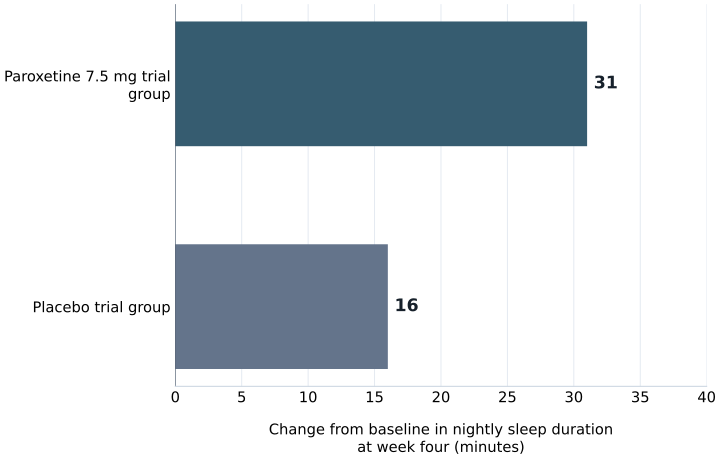
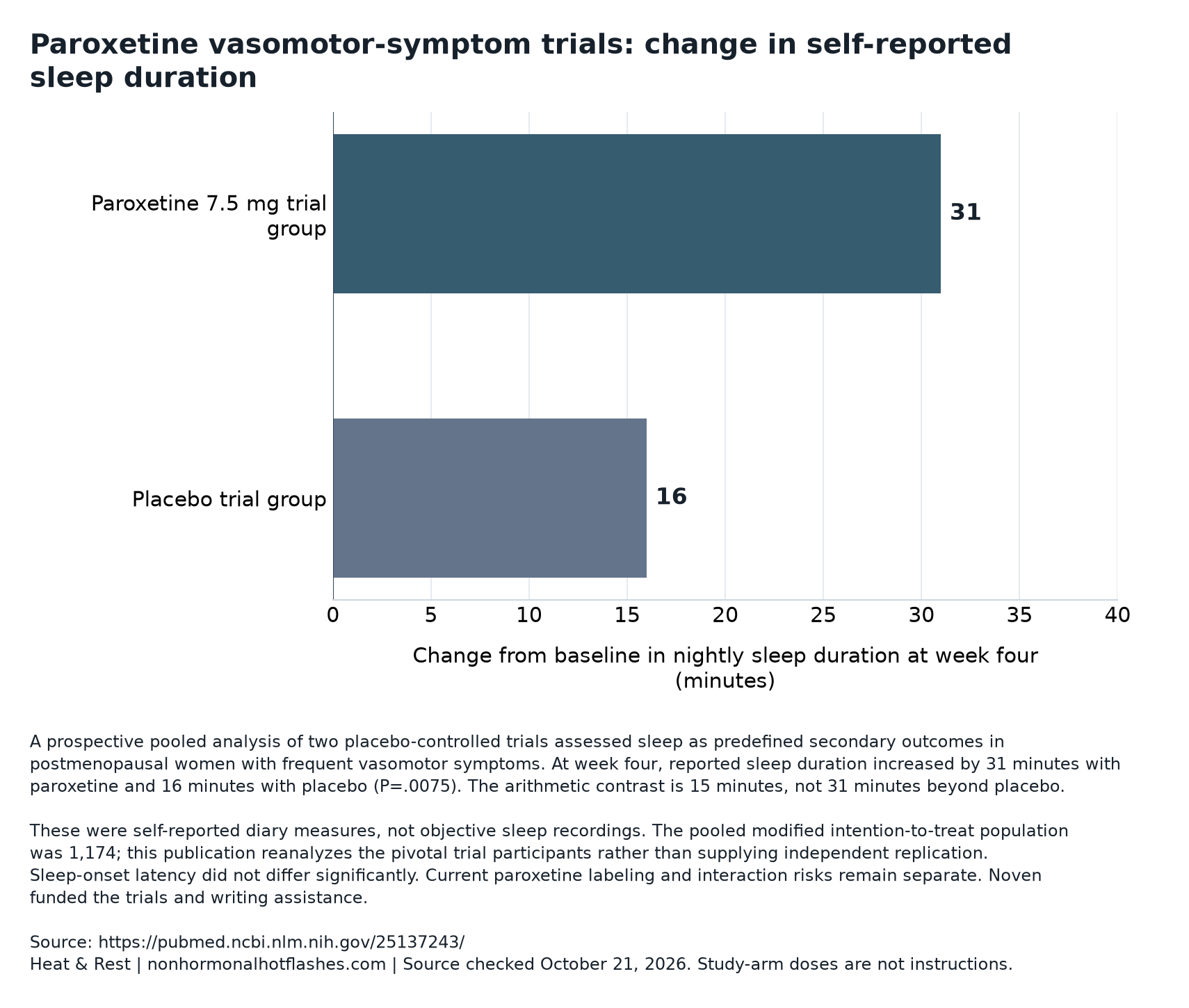
For Heat & Rest, the central finding is specific: the additional sleep benefit was smaller than the improvement measured within the paroxetine group alone. At four weeks, reported sleep duration increased by 31 minutes with paroxetine and 16 minutes with placebo—a 15-minute arithmetic contrast. Understanding that comparison requires separating the original hot-flash trials from their secondary sleep analysis, and both from current medicine-specific safety information.
Two trials assigned 591 postmenopausal women to oral paroxetine 7.5 mg and 593 to placebo, with treatment lasting 12 or 24 weeks.
In this article
Study facts at a glance
Randomized population: Two trials assigned 591 postmenopausal women to oral paroxetine 7.5 mg and 593 to placebo, with treatment lasting 12 or 24 weeks. Source 1 Source 2
Primary hot-flash findings: The 24-week trial met all four primary endpoints; the 12-week trial met three, missing the week-12 severity endpoint. Source 1 Source 3
Nighttime waking: At week 4, awakenings attributed to vasomotor symptoms fell 39% with paroxetine versus 28% with placebo. Source 2
Sleep duration: Week-4 increases were 31 versus 16 minutes per night—not 31 minutes beyond placebo. Source 2
Current safety context: Brisdelle carries a boxed warning about suicidal thoughts and behaviors, along with important interaction and other safety warnings. Source 3
Two trials, with sleep questions nested inside them
The phase 3 program comprised two multicenter, randomized, double-blind studies comparing paroxetine 7.5 mg with an identical placebo capsule. Participants took the oral study treatment once daily at bedtime. One trial randomized 614 women and followed treatment for 12 weeks; the other randomized 570 and followed treatment for 24 weeks. These doses describe the research arms, not personal treatment instructions.
The four primary efficacy endpoints were changes in moderate-to-severe vasomotor symptom frequency and severity at weeks 4 and 12. Vasomotor symptoms, or VMS, encompass hot flashes and night sweats. Frequency counts episodes; severity describes their intensity. The distinction matters because fewer episodes and milder remaining episodes are different benefits, as explained in our guide to frequency, severity, and daily impact.
Sleep measures were prospectively defined secondary outcomes in these same participants. Investigators pooled the two trials through week 12; week-24 results came only from the longer trial. The sleep publication therefore adds detail, not an independent replication. This analysis draws on the indexed primary hot-flash report abstract, the full sleep research article, and official prescribing information; it does not assume access to every original protocol or supplement.
Read the underlying chart data: download CSV or download the source-labeled chart.
Participants had frequent symptoms, not necessarily diagnosed insomnia
Participants were postmenopausal women aged at least 40 years, including women with natural or surgical menopause. Eligibility required roughly more than seven to eight moderate-to-severe hot flashes daily, or 50 to 60 weekly, for at least 30 days before screening. In the pooled analysis, baseline average frequency was 11.3 episodes daily. This was a substantially symptomatic population, not a general sample of everyone experiencing menopause.
The studies excluded women with psychiatric disorder histories, impaired liver or kidney function, unstable cardiac disease, and several other conditions. Known failure of a previous SSRI or related antidepressant treatment for VMS also excluded participation. No sleep-specific selection rules excluded sleep apnea or restless legs. Limited use of certain permitted sleep medicines occurred, but investigators did not analyze its influence separately.
Of 1,184 randomized participants, 1,174 qualified for the modified intent-to-treat analysis, which required valid baseline diaries, at least one treatment dose, and on-treatment diary data. The safety analysis included 1,175. These counts answer different questions and explain why official efficacy tables show fewer participants than the randomization total. More than 80% completed the studies, but completion does not make the selected population representative of every patient.
Hot-flash frequency improved more consistently than severity
Both trials found significantly greater reductions in hot-flash frequency with paroxetine at weeks 4 and 12. However, only the 24-week trial met all four primary endpoints. In the shorter trial, the week-12 severity difference was not statistically significant; the current label reports P = 0.17. Calling the program uniformly positive across every endpoint would erase that exception.
The label’s daily-frequency medians help put the findings in practical units. In the shorter trial at week 12, the median reduction was 5.9 episodes with paroxetine versus 5.0 with placebo, a difference between median changes of 0.9 episode daily. In the longer trial at that visit, reductions were 5.6 versus 3.9, a 1.7-episode difference. These are medians, not the mean changes used for the sleep-duration results.
At week 24, 48% receiving paroxetine and 36% receiving placebo achieved at least a 50% reduction in VMS frequency. That is a 12-percentage-point difference in responder proportions—not a 48% average reduction in the group. The results support persistence through six months in one trial, rather than establishing indefinite benefit.
Primary hot-flash endpoints and longer-term response
| Outcome | 12-week trial | 24-week trial |
|---|---|---|
| Week-4 frequency and severity | Both significantly favored paroxetine | Both significantly favored paroxetine |
| Week-12 frequency and severity | Frequency significant; severity not significant | Both significantly favored paroxetine |
| Week-12 daily frequency median change | −5.9 paroxetine; −5.0 placebo | −5.6 paroxetine; −3.9 placebo |
| Week-24 participants achieving at least 50% frequency reduction | Not assessed at week 24 | 48% paroxetine; 36% placebo |
The waking result depended on what women attributed to heat
Participants used morning electronic diaries to report awakenings they attributed to VMS. At baseline, they averaged approximately 3.6 such awakenings nightly. This endpoint did not count every awakening regardless of cause, measure how long each waking lasted, or verify heat events and sleep stages with laboratory monitoring. Our night-sweats and sleep guide explains why describing the waking itself matters.
At week 4, the paroxetine group moved from 3.56 to 2.17 attributed awakenings nightly, a 39% reduction. Placebo moved from 3.64 to 2.63, a 28% reduction. The changes were therefore 1.39 and 1.01 fewer awakenings, leaving an additional reduction of 0.38 nightly with paroxetine. Subtracting the final values instead gives 0.46 because the starting averages differed slightly.
The percentage-reduction gap was 11 percentage points, not an additional 39% reduction beyond placebo. At week 12, reductions were 54% versus 43%. In the longer trial alone, week-24 reductions were 62% versus 43%, with final averages of 1.36 versus 2.02. Those later results support sustained improvement in attributed waking, but they do not establish fewer awakenings from unrelated causes.
Longer sleep was a modest additional gain
Reported nighttime sleep duration increased significantly more with paroxetine at each scheduled assessment. At week 4, increases were 31 minutes versus 16 minutes with placebo; at week 12, 35 versus 23; at week 24, 37 versus 27. The arithmetic contrasts were consequently 15, 12, and 10 minutes. Presenting only the active-treatment changes would overstate the incremental benefit demonstrated by the comparison.
These figures are group averages, not promises about an individual night. The sleep report does not provide confidence intervals for these estimates in the accessible numerical text, limiting assessment of their precision. Statistical significance indicates evidence of a group difference under the analysis; it does not reveal how many women gained an amount of sleep they personally considered worthwhile.
The smaller week-24 contrast also should not be treated as proof that benefit steadily faded: that visit represents only one trial, whereas earlier values pool both. Meanwhile, improvements in the placebo groups were substantial. The design cannot divide that improvement precisely among expectations, natural symptom fluctuation, repeated reporting, and other influences; it does show why baseline change alone is insufficient.
Reported sleep changes: treatment gains versus the additional comparison
| Assessment | Paroxetine versus placebo | Interpretation |
|---|---|---|
| Week-4 attributed awakenings | 39% versus 28% reduction | 11-percentage-point gap; 0.38 additional awakening reduction nightly |
| Week-4 sleep duration | +31 versus +16 minutes | 15-minute arithmetic contrast |
| Week-12 sleep duration | +35 versus +23 minutes | 12-minute arithmetic contrast |
| Week-24 sleep duration | +37 versus +27 minutes | 10-minute arithmetic contrast; longer trial only |
| Sleep-onset latency | No significant between-group difference | No demonstrated advantage in time to fall asleep |
Several sleep measures did not confirm a broad benefit
Sleep-onset latency means the time needed to fall asleep. At week 4, it decreased by seven minutes with paroxetine and eight with placebo; at week 12, by 11 and 14 minutes. Neither visit showed a statistically significant treatment difference, and neither did week 24. Thus, the positive waking and duration findings cannot be translated into evidence that paroxetine helped participants fall asleep faster.
Broader subjective measures were mixed as well. A sleep-interference item from the Hot Flash–Related Daily Interference Scale favored paroxetine significantly at week 4, but not at weeks 12 or 24. The proportion reporting moderate-to-severe difficulty sleeping on the Greene Climacteric Scale did not differ significantly between treatments at any assessed visit. Moreover, the isolated sleep-interference item had not been validated as a standalone sleep measure.
Interpretation: the pattern is compatible with a targeted improvement in heat-associated sleep disruption rather than a general sedative effect. It does not prove the mechanism. Self-reported waking and sleep duration cannot establish that reducing hot flashes caused every extra minute of sleep. Objective sleep monitoring and validated insomnia-specific measures would help resolve that question.
Sleep-related adverse events are only one part of safety
During treatment, 3.1% in each arm reported at least one sleep-related treatment-emergent adverse event. After discontinuation, the corresponding proportions were 1.4% with paroxetine and 0.3% with placebo. Individual sleep-related events did not differ significantly between arms. Somnolence was reported in 0.5% of paroxetine recipients. These are sleep-event findings, not the overall incidence of adverse effects.
The current Brisdelle label pools a broader safety population, including an additional phase 2 trial: 635 active-treatment recipients and 641 placebo recipients. Headache occurred in 6.3% versus 4.8%, fatigue-related reactions in 4.9% versus 2.8%, and nausea or vomiting in 4.3% versus 2.3%. Adverse reactions led to discontinuation in 4.7% versus 3.7%. Those denominators should not be substituted for the two-trial sleep population.
No significant sedation difference does not mean sedation is impossible for an individual. Likewise, limited short-term discontinuation findings do not eliminate withdrawal-related risk. Current labeling describes symptoms including nightmares, anxiety, fatigue, and insomnia after discontinuation. The historical study procedures are not a personal stopping or tapering plan.
Low dose does not remove psychiatric or interaction warnings
Brisdelle is approved for moderate-to-severe menopausal VMS, not insomnia or psychiatric conditions. Its boxed warning addresses suicidal thoughts and behaviors associated with SSRIs and calls for monitoring. Despite psychiatric-history exclusions, the label’s pooled phase 2 and phase 3 safety data report three serious suicidal-ideation reactions and one suicide-attempt reaction in active-treatment recipients, versus none with placebo. These small counts do not yield a precise individual risk estimate.
Paroxetine strongly inhibits CYP2D6, an enzyme involved in processing other medicines. The label warns that it can reduce concentrations of tamoxifen’s active metabolite. Studies of clinical outcomes have been mixed, but the potential interaction remains important when tamoxifen is used for breast cancer treatment or prevention. This is not a universal claim that recurrence will occur, nor is tamoxifen listed as an absolute contraindication.
Other label concerns include potentially life-threatening serotonin syndrome, increased bleeding risk with medicines such as NSAIDs or anticoagulants, low blood sodium, sexual dysfunction, and mood activation. MAO inhibitors, thioridazine, and pimozide are among contraindicated combinations. A medicine-specific safety review is therefore more informative than assuming that nonhormonal or low-dose means risk-free.
Fezolinetant supplies context, not a head-to-head ranking
The sleep paper’s historical description of paroxetine as the only approved nonhormonal VMS treatment is no longer current. Fezolinetant is another approved option. In SKYLIGHT 1, 527 women were randomized to placebo or oral fezolinetant 30 mg or 45 mg. The trial had 12 placebo-controlled weeks followed by a 40-week active-treatment extension, not a full year of placebo comparison.
The indexed SKYLIGHT 1 abstract reports a week-12 frequency difference of 2.55 fewer daily episodes beyond placebo for the 45 mg arm, with standard error 0.43. The current label rounds that contrast to 2.6 fewer episodes, with a 95% confidence interval from 1.7 to 3.4 fewer. Standard errors and confidence intervals are different descriptions of uncertainty. Our SKYLIGHT 1 analysis examines that study separately; its results do not establish superiority over paroxetine.
Current fezolinetant labeling carries a boxed hepatotoxicity warning after postmarketing liver injury reports. It specifies baseline liver testing and follow-up monthly for three months, then at months 6 and 9. The early trial’s relatively few liver-enzyme events cannot override that later evidence. Nor can adverse-event percentages from different drug programs reliably rank their safety.
What remains unresolved—and what care claims should document
Both paroxetine trials and their medical writing support were funded by Noven Pharmaceuticals. Two sleep-paper authors were company employees, and other authors disclosed consulting, research, or travel relationships. Sponsorship does not erase the randomized comparisons, but the shared funding and shared participants reinforce why the sleep paper should not be counted as outside confirmation.
Important unanswered questions concern objective sleep changes, awakenings unrelated to VMS, the duration of nighttime wakefulness, and benefits beyond 24 weeks. The exclusions also leave uncertainty about applicability to people with psychiatric histories or significant organ disease. A future study could pair symptom diaries with objective sleep measurement and validated insomnia scales to determine whether perceived improvements correspond to broader restoration of sleep.
Editorial interpretation: a care offer should distinguish its symptom target, follow-up arrangements, and billing terms from the medicine’s trial results. The hot-flash claim checklist provides a framework. Readers checking documentary terms can also consult the Midi review or Evernow review. Those links do not establish that either provider offers the studied product or delivers these outcomes. Evidence for the studied capsule does not automatically transfer to compounded preparations, other formulations, or a provider’s services.
Questions about the evidence
Was the sleep publication a third clinical trial?
No. It analyzed predefined secondary sleep outcomes from the same two pivotal trials. Data were pooled through week 12, while week-24 findings came only from the longer trial. It adds useful information about the original participants without adding an independently recruited replication population.
Does the 39% reduction mean paroxetine prevented 39% more awakenings than placebo?
No. It was a reduction from the paroxetine group’s own baseline. Placebo recipients improved by 28%, leaving an 11-percentage-point gap between percentage reductions. Using the reported awakening counts, the additional reduction associated with paroxetine was 0.38 awakening per night at week 4.
Did participants gain half an hour of sleep because of the medicine?
The active-treatment group reported about half an hour more sleep than at baseline, but placebo recipients also gained sleep. At week 4, the changes were 31 versus 16 minutes. The 15-minute contrast better describes the additional average gain demonstrated by the comparison, rather than attributing the entire 31 minutes to treatment.
Do these findings establish a treatment for general insomnia?
No. Participants were selected for frequent menopausal hot flashes, not an insomnia diagnosis. The positive findings concerned attributed awakenings and reported sleep duration. Falling-asleep time and several broader sleep measures did not show significant advantages, and Brisdelle’s approved indication is menopausal VMS rather than insomnia.
Does the absence of a significant sedation difference rule out sleep-related side effects?
No. A group comparison cannot guarantee that an individual will not experience drowsiness, insomnia, or another reaction. Sleep-related adverse events occurred in both arms, and current labeling describes sleep symptoms after discontinuation. The narrow trial finding should be read alongside the full current safety information.
What this evidence supports
The evidence supports a specific, modest additional sleep benefit alongside reduced menopausal hot-flash frequency: fewer self-attributed heat-related awakenings and longer reported sleep than with placebo. It does not establish broad insomnia relief, faster sleep onset, or a sedation-free experience for every user. The strongest interpretation preserves the placebo comparison, the missed severity endpoint, the secondary nature of sleep outcomes, and current psychiatric and interaction warnings.
Research access and limitations
The original VMS report and SKYLIGHT 1 comparison were available as indexed primary abstracts; the full paroxetine sleep article and official prescribing information supplied additional methods, results, and safety context. Sleep measures were self-reported secondary outcomes, and the pivotal paroxetine follow-up extended no longer than 24 weeks.
Source notes
References support the claims beside them. Provider pages describe an offer; they do not demonstrate treatment outcomes.
- Low-dose paroxetine 7.5 mg for menopausal vasomotor symptoms: two randomized controlled trials.Indexed primary study abstract · Checked 2026-10-21
- Low-dose paroxetine (7.5 mg) improves sleep in women with vasomotor symptoms associated with menopause.Indexed primary study abstract and full research article · Checked 2026-10-21
- DailyMed — BRISDELLE paroxetine capsule, Legacy Pharma USA, Inc.Exact capsule prescribing information revised April 2025. Menopausal vasomotor indication and current safety information remain separate from older secondary sleep outcomes and from a clinic formulary. · Checked 2026-10-21
- Fezolinetant for treatment of moderate-to-severe vasomotor symptoms associated with menopause (SKYLIGHT 1): a phase 3 randomised controlled study.Indexed primary study abstract · Checked 2026-10-21
- DailyMed — VEOZAH fezolinetant tablet, Astellas Pharma US, Inc.Complete current prescribing information revised February 2026, including boxed hepatotoxicity warning, all three contraindications, liver-assessment duties and patient warning response. Vasomotor indication is not an insomnia indication; no personal laboratory calendar or eligibility decision. · Checked 2026-10-21