Scientific article · Sources checked October 21, 2026
SKYLIGHT 1: Fezolinetant Symptom Results and Current Liver-Safety Evidence
The 527-participant randomized trial established a benefit for hot-flash frequency and severity over 12 weeks. Its extension, separate sleep research, and current boxed liver warning answer different questions.
Public-source editorial research · No clinician sign-off or firsthand treatment testing
A reduction in daily hot flashes is not the same outcome as sleeping longer, falling asleep faster, or avoiding medication harm. SKYLIGHT 1 provides clear evidence that fezolinetant reduced moderate-to-severe menopausal vasomotor symptoms—hot flashes and night sweats—more than placebo. Understanding that benefit requires separating the change during treatment from the additional improvement beyond placebo, then reading the early safety findings alongside current prescribing information.
This analysis uses the indexed primary report abstract for SKYLIGHT 1 and the available official VEOZAH prescribing information, revised February 2026. For comparison of outcome types, it also examines the indexed paroxetine trial report, its full published sleep analysis, and current BRISDELLE labeling. These are not head-to-head studies. Together, they illustrate why evidence about heat, sleep, and safety should remain distinct rather than becoming one broad promise of relief.
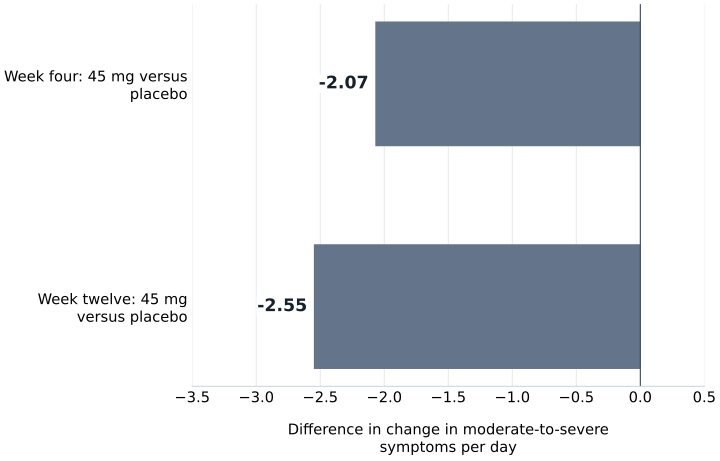
SKYLIGHT 1 assigned 527 women aged 40–65 with at least seven moderate-to-severe hot flashes per day on average to placebo or one of two fezolinetant arms.
In this article
Study facts at a glance
Randomized population: SKYLIGHT 1 assigned 527 women aged 40–65 with at least seven moderate-to-severe hot flashes per day on average to placebo or one of two fezolinetant arms. Source 1
Controlled comparison: The placebo-controlled period lasted 12 weeks, followed by a 40-week active-treatment extension—not 52 weeks of placebo comparison. Source 1 Source 2
45 mg frequency finding: The placebo-adjusted differences in daily symptom-frequency change were −2.07 at week 4 and −2.55 at week 12. Source 1
Sleep evidence boundary: The SKYLIGHT 1 abstract establishes frequency and severity findings; it does not supply a quantitative sleep benefit. Separate paroxetine sleep findings came from different trials. Source 1 Source 4
Current liver-safety requirements: VEOZAH carries a boxed hepatotoxicity warning, with liver testing before treatment, monthly for the first three months, and at months 6 and 9. Source 2
The trial enrolled women with a substantial daily symptom burden
SKYLIGHT 1 was a phase 3 randomized, double-blind trial at 97 facilities in seven countries, including the United States and Canada. Eligible women were aged 40–65 and averaged at least seven moderate-to-severe hot flashes daily. Of 2,205 women recruited, 527 were randomized: 175 to placebo and 176 to each fezolinetant arm. The larger recruitment figure is not the number who entered the randomized comparison.
Participants received once-daily oral treatment: matched placebo, fezolinetant 30 mg, or fezolinetant 45 mg. These doses identify research arms, not personal treatment instructions. Current US VEOZAH labeling specifies a 45 mg oral tablet; the 30 mg research arm should not be read as an alternative approved US regimen.
A web-based system assigned treatment, and participants, investigators, clinical staff, and project team members were masked to assignment. This design supports a causal comparison with placebo within the studied population. It does not establish effectiveness for every menopausal symptom, women outside the age range, or people with much less frequent symptoms.
Read the underlying chart data: download CSV or download the source-labeled chart.
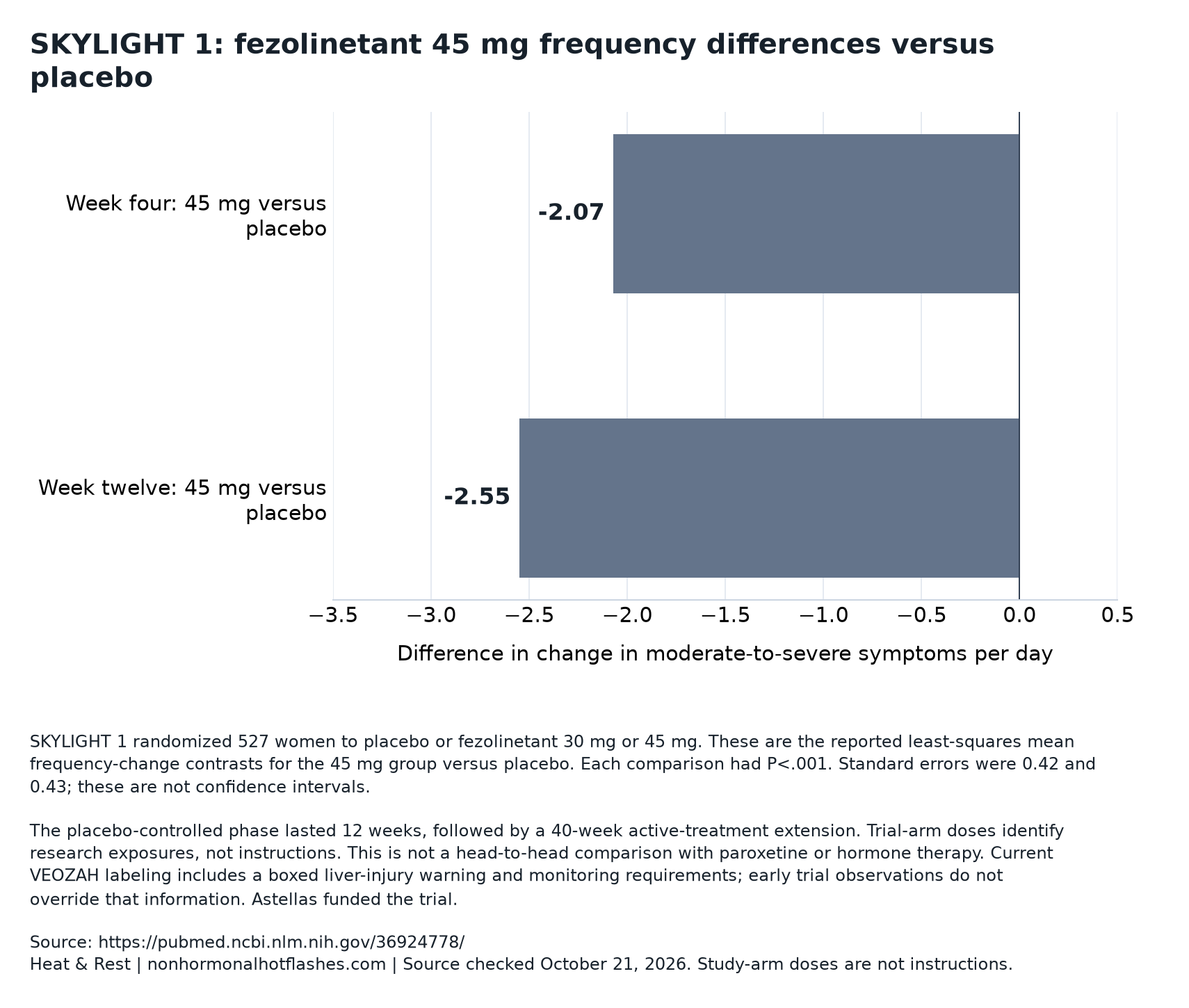
Frequency and severity were separate primary outcomes
The coprimary endpoints were changes from baseline in symptom frequency and severity at weeks 4 and 12. Frequency counts how often symptoms occur; severity describes their intensity. A treatment might reduce one more convincingly than the other. Neither measurement is interchangeable with sleep duration, daytime functioning, or a global quality-of-life score.
Fezolinetant blocks the neurokinin 3 receptor, part of a signaling pathway involved in temperature regulation. The official label describes modulation of neurons in the brain’s thermoregulatory center. That mechanism explains the treatment’s biological target, but the clinical evidence still rests on measured symptom changes—not an assumption that targeting temperature regulation automatically improves every related complaint.
The practical distinction is developed in our guide to hot-flash frequency, severity, and daily impact. For SKYLIGHT 1, four primary comparisons across two time points provide the central efficacy evidence. A reader should ask which outcome improved, by how much, and relative to what comparator before interpreting a general claim of menopause relief.
The 45 mg benefit was about two to three fewer daily flashes beyond placebo
For the 45 mg arm, the primary abstract reports placebo-adjusted frequency differences of −2.07 daily episodes at week 4 and −2.55 at week 12, both with P values below 0.001. These are differences in model-estimated mean changes. A negative value favors fezolinetant because a larger decline means fewer symptoms.
The official label helps unpack the comparison. In its rounded Trial 1 results, baseline frequency averaged 10.4 daily episodes with 45 mg and 10.5 with placebo. At week 4, estimated changes were −5.4 and −3.3; at week 12, −6.4 and −3.9. Subtracting the placebo change explains why the incremental drug benefit is smaller than the total improvement during active treatment.
The abstract gives standard errors, not confidence intervals: 0.42 at week 4 and 0.43 at week 12 for the 45 mg contrasts. The label separately reports rounded estimates with 95% confidence intervals, shown below. Those intervals describe uncertainty around the average treatment difference, not the range of responses individual women should expect.
SKYLIGHT 1 frequency findings for the 45 mg arm: abstract estimates and rounded official-label context
| Measure | Week 4 | Week 12 |
|---|---|---|
| Abstract: difference in daily frequency change versus placebo | −2.07; standard error 0.42 | −2.55; standard error 0.43 |
| Label: estimated daily frequency change, 45 mg versus placebo | −5.4 versus −3.3 | −6.4 versus −3.9 |
| Label: rounded difference versus placebo, with 95% confidence interval | −2.1; −2.9 to −1.3 | −2.6; −3.4 to −1.7 |
Placebo improvement and severity changes put the headline in perspective
The placebo arm’s improvement is a substantive finding, not statistical clutter. At week 12, its estimated frequency reduction was almost four daily episodes. Randomization allows researchers to separate the added average benefit of fezolinetant from improvement also observed without active medication. It does not identify how much placebo-group change came from expectations, symptom fluctuation, study participation, or other influences.
Severity also improved beyond placebo. In the 45 mg arm, the abstract reports differences of −0.19 severity units at week 4 and −0.20 at week 12, with P values of 0.002 and 0.007. These are scale units, not percentages, episode counts, or minutes of sleep. The label’s rounded severity confidence intervals are −0.3 to −0.1 and −0.4 to −0.1, respectively.
The 30 mg arm also met the reported frequency and severity comparisons against placebo. Its frequency differences were −1.87 and −2.39 daily episodes at weeks 4 and 12; severity differences were −0.15 and −0.24. These findings do not establish that either dose outperformed the other. The abstract reports comparisons with placebo, not a demonstrated dose-superiority result.
The extension supports persistence, with a different comparison
The report describes improvement beginning after one week and maintained over 52 weeks. However, the study’s architecture changes after week 12. The next 40 weeks were an active-treatment extension. Official labeling explains that women previously receiving placebo were reassigned to active treatment, while those already receiving fezolinetant continued active treatment.
Consequently, the yearlong observation supports persistence of improvement among participants followed during active treatment, but it does not measure a yearlong difference from continued placebo. Without that ongoing control, the extension cannot isolate the same counterfactual question: what would symptoms have been over that period without active treatment?
Before week 12, treatment discontinuation occurred in 23 placebo participants, 31 assigned to 30 mg, and 13 assigned to 45 mg, mostly because of adverse events or participant withdrawal. Those totals are not all adverse-event withdrawals. Differential discontinuation also matters when considering longer-term results: the women remaining under observation need not represent every woman who initially entered the trial.
A hot-flash endpoint does not answer the whole sleep question
The accessible SKYLIGHT 1 abstract does not provide a numerical sleep outcome. Its positive frequency and severity results therefore should not be converted into a claim about additional minutes asleep, fewer awakenings, or faster sleep onset. This is an evidence boundary, not proof that sleep cannot improve. Different sleep questions require their own measurements.
Separate paroxetine research illustrates the distinction. Two randomized placebo-controlled trials assigned 1,184 postmenopausal women to oral paroxetine 7.5 mg or placebo; the predefined sleep analysis used self-reported diaries as secondary outcomes. Data through week 12 were pooled, whereas week 24 came only from the longer trial. This was another analysis of the same pivotal trials, not independent replication.
At week 4, sleep duration increased by 31 minutes with paroxetine and 16 with placebo—a 15-minute difference in changes, not a 31-minute placebo-adjusted gain. Sleep-onset latency did not differ significantly. Our paroxetine trial and sleep analysis explores these results, while the night-sweats and sleep guide explains why attributed awakenings and all-cause sleep disturbance are different targets.
Different evidence questions—not a head-to-head comparison of medicines
| Evidence | Measured result | Interpretive boundary |
|---|---|---|
| SKYLIGHT 1, fezolinetant 45 mg | Daily frequency-change difference versus placebo: −2.55 at week 12 | A frequency endpoint does not quantify sleep improvement |
| Paroxetine pooled sleep analysis, week 4 | VMS-attributed awakenings declined 39% versus 28% with placebo | An 11-percentage-point gap in within-group reductions; not a measure of all awakenings |
| Paroxetine pooled sleep analysis, week 4 | Sleep duration increased 31 versus 16 minutes | The difference in changes was 15 minutes; sleep was self-reported |
| Paroxetine sleep analysis across assessments | No significant between-group sleep-onset latency difference | Improvement in one sleep measure did not establish improvement in every sleep domain |
Short-term adverse-event totals are not a liver-safety verdict
During the first 12 weeks, treatment-emergent adverse events occurred in 37% of the 30 mg safety group, 43% of the 45 mg group, and 45% of placebo recipients. These events arose during treatment and were not necessarily caused by it. Similar or lower overall event percentages cannot establish that a medicine lacks a particular serious risk.
The denominators require care. The safety groups included 175 placebo recipients, 174 receiving 30 mg, and 173 receiving 45 mg. The reported efficacy groups instead included 173 in the 30 mg arm and 174 in the 45 mg arm, reflecting the handling of a participant assigned 45 mg who received 30 mg in error. Randomized, treated, and analyzed counts are not interchangeable.
The abstract recorded one liver-enzyme elevation with placebo, two with 30 mg, and none with 45 mg during the initial period. These few historical events cannot estimate current real-world liver-injury incidence or exclude rare harm. The broader principle in medicine-specific nonhormonal safety is especially relevant here: absence of hormones does not mean absence of monitoring obligations.
Current labeling changes the liver-risk interpretation
The February 2026 VEOZAH label carries a boxed warning for hepatotoxicity, meaning liver toxicity. Across three clinical trials, ALT or AST liver-enzyme elevations above three times the upper limit of normal occurred in 2.3% receiving VEOZAH and 0.9% receiving placebo. That is a 1.4-percentage-point difference in observed proportions, not a 1.4% relative increase. These pooled laboratory findings are not the incidence of serious liver injury.
The label also describes serious postmarketing drug-induced liver injury occurring within 40 days of treatment initiation. Reported features included elevated liver enzymes and bilirubin, fatigue, nausea, itching, jaundice, pale stools, and dark urine. Abnormalities gradually resolved after discontinuation. Voluntary reports from a population of uncertain size cannot supply a reliable event frequency.
Longer-term adverse reactions also deserve attention. In a separate 52-week placebo-controlled safety trial summarized in the label, abdominal pain occurred in 4.3% versus 2.1%, diarrhea in 3.9% versus 2.6%, and insomnia in 3.9% versus 1.8%. These are not SKYLIGHT 1’s 12-week event rates. Insomnia appearing as an adverse reaction further underscores why hot-flash efficacy cannot be treated as a universal sleep benefit.
Monitoring and contraindications are part of the treatment evidence
Current labeling calls for baseline ALT, AST, alkaline phosphatase, and total and direct bilirubin testing. It specifies that treatment should not begin if ALT or AST is at least twice the laboratory’s upper limit of normal, or total bilirubin is at least twice that limit. Scheduled follow-up testing is monthly for the first three months, then at months 6 and 9.
The exact contraindications are known cirrhosis, severe renal impairment or end-stage renal disease, and concomitant CYP1A2 inhibitors. The interaction prohibition includes weak, moderate, and strong inhibitors. Separately, the boxed warning directs immediate discontinuation and medical evaluation for symptoms suggesting liver injury, and specifies laboratory stopping thresholds above five times normal for transaminases, or above three times normal together with bilirubin above twice normal.
Editorial interpretation: monitoring makes reliable result review and follow-up part of the care pathway, not an optional extra. No cost estimate follows from these trials. When examining documentary terms, the Midi review and Evernow review can help frame questions about visit charges, laboratory arrangements, and follow-up responsibilities. Those links do not establish availability of the studied medicine or equivalent outcomes.
Comparison, sponsorship, and remaining questions
Astellas Pharma funded SKYLIGHT 1. Noven Pharmaceuticals funded the paroxetine pivotal studies and medical-writing support; the sleep paper disclosed employee authors and other industry relationships. Sponsorship does not erase randomized results, but it belongs in their appraisal. The accessible SKYLIGHT 1 evidence here is its indexed abstract and official labeling, not a review of all protocols, supplements, or individual participant data.
There was no direct comparison with paroxetine or hormone therapy. Even numerical comparisons can mislead: SKYLIGHT reports model-estimated mean differences, while BRISDELLE labeling presents median frequency changes. BRISDELLE also has its own boxed warning about suicidal thoughts and behaviors, plus serotonergic, bleeding, and drug-interaction concerns. Its pooled phase 2/3 safety data reported three serious suicidal-ideation reactions and one suicide attempt with active treatment versus none with placebo.
Unresolved questions include which individuals experience meaningful sleep gains, how symptom improvement relates to daily functioning, and the frequency and predictors of serious liver injury in practice. The hot-flash claim checklist offers a useful reading framework: preserve the population, outcome, comparator, and time period. Clinical results also do not automatically transfer to providers, compounded preparations, or different formulations.
Questions about the evidence
Does −2.55 mean women had only 2.55 fewer hot flashes overall?
No. It is the additional average reduction relative to placebo at week 12. The official label reports rounded estimated reductions of 6.4 daily episodes with 45 mg and 3.9 with placebo. The difference between those improvements represents the incremental treatment effect, rather than the full change observed during active treatment.
Was fezolinetant compared with placebo for a full year?
Not in SKYLIGHT 1. Its placebo-controlled period lasted 12 weeks, followed by 40 weeks of active treatment. Continued improvement during the extension supports persistence but cannot establish the same yearlong placebo-adjusted effect. The label separately describes a different 52-week placebo-controlled safety trial; those designs should not be merged.
Does SKYLIGHT 1 prove better sleep?
The indexed abstract provides numerical frequency and severity results, not a quantified sleep benefit. Separate paroxetine trials measured attributed awakenings, sleep duration, and sleep onset, with different findings across those domains. Their results illustrate the importance of measuring sleep directly, but they cannot supply a fezolinetant sleep estimate or establish comparative superiority.
Why does current liver guidance matter if no elevations appeared in the 45 mg group initially?
A small group observed briefly can miss uncommon harms. Broader trial data documented elevated liver enzymes, and postmarketing reports identified serious liver injury. Current labeling therefore includes a boxed warning and scheduled testing. The early zero count is a historical observation, not evidence of zero current risk or a reason to disregard monitoring.
Can these results identify the best nonhormonal medicine?
No. SKYLIGHT 1 compared fezolinetant with placebo, not another active medicine. Paroxetine evidence comes from different populations, analyses, and outcome measures, with its own safety requirements. Establishing a treatment ranking would require suitable comparative evidence; placing unrelated trial numbers side by side does not create a head-to-head study.
What this evidence supports
SKYLIGHT 1 provides persuasive randomized evidence of reduced moderate-to-severe hot-flash frequency and severity over 12 weeks. The clinically useful headline is an additional average reduction of roughly two to three daily episodes with the 45 mg arm beyond placebo—not proof of comprehensive sleep recovery. Longer observation supports persistence under active treatment, while current liver-safety evidence adds obligations the early abstract alone could not convey. Benefit, sleep outcomes, and medicine-specific harm remain three linked but separate assessments.
Research access and limitations
SKYLIGHT 1 interpretation relies on its indexed primary abstract and current official labeling, rather than examination of all full-text methods or supplements. The paroxetine sleep full article was available, but it analyzes different trials and is not comparative fezolinetant evidence. Postmarketing reports do not establish a reliable serious-liver-injury incidence.
Source notes
References support the claims beside them. Provider pages describe an offer; they do not demonstrate treatment outcomes.
- Fezolinetant for treatment of moderate-to-severe vasomotor symptoms associated with menopause (SKYLIGHT 1): a phase 3 randomised controlled study.Indexed primary study abstract · Checked 2026-10-21
- DailyMed — VEOZAH fezolinetant tablet, Astellas Pharma US, Inc.Complete current prescribing information revised February 2026, including boxed hepatotoxicity warning, all three contraindications, liver-assessment duties and patient warning response. Vasomotor indication is not an insomnia indication; no personal laboratory calendar or eligibility decision. · Checked 2026-10-21
- Low-dose paroxetine 7.5 mg for menopausal vasomotor symptoms: two randomized controlled trials.Indexed primary study abstract · Checked 2026-10-21
- Low-dose paroxetine (7.5 mg) improves sleep in women with vasomotor symptoms associated with menopause.Indexed primary study abstract and full research article · Checked 2026-10-21
- DailyMed — BRISDELLE paroxetine capsule, Legacy Pharma USA, Inc.Exact capsule prescribing information revised April 2025. Menopausal vasomotor indication and current safety information remain separate from older secondary sleep outcomes and from a clinic formulary. · Checked 2026-10-21